


Moneta Markets Receives UAE Category 5 Licence
Moneta Global Financial Services LLC has received a Category 5 licence from the UAE Capital Market Authority, establishing a regulated structure for the company’s activities in the country.
Original

简体中文
繁體中文
English
Pусский
日本語
ภาษาไทย
Tiếng Việt
Bahasa Indonesia
Español
हिन्दी
Filippiiniläinen
Français
Deutsch
Português
Türkçe
한국어
العربية
اردو




Abstract:Discover the Swiss National Bank's groundbreaking move as they launch a wholesale Central Bank Digital Currency (CBDC) pilot on SIX Digital Exchange. Explore the tangible financial implications of this real-life venture, aiming to test transactions with various stakeholders. Uncover the SNB's distinct approach to CBDCs and their cautious stance on retail CBDCs, while preserving the enduring value of physical cash.

Switzerland's central banking institution, the Swiss National Bank (SNB), has announced plans to launch a trial for a wholesale Central Bank Digital Currency (CBDC) via the nation's SIX digital exchange. This innovative pilot program was announced by the central bank's chairman, Thomas Jordan, during a speech at the Point Zero Forum in Zurich.
The decision to introduce a digital currency into the market isn't merely theoretical, but a real-life venture with tangible financial implications. Jordan highlighted that the CBDC will act as actual money, comparable to bank reserves, with the specific purpose of testing real transactions with various market stakeholders.
While the start date for the pilot program remains undisclosed, it is expected to commence “soon” and, for the moment, is scheduled for a limited duration.
The evolution of digital payments and the dwindling reliance on physical cash, especially exacerbated by the COVID-19 pandemic, has prompted global central banks to delve into digital currency alternatives. This transition aims to prevent the private sector from monopolizing digital payments, which could potentially disrupt financial ecosystems.
The Swiss National Bank's wholesale CBDC, unlike other CBDCs that utilize tokenized securities, presents a distinct approach. The SNB has traditionally been skeptical about implementing public, or retail, CBDCs, mainly due to the risks they pose to the stability of the financial system and the difficulty in their regulation.
Thomas Jordan expressed his concerns about retail CBDCs, stressing that while the SNB doesn't completely rule out the possibility of their introduction, it is currently adopting a more cautious stance.
However, even as the Swiss central bank is keen to explore the digital realm, it doesn't envision the complete obsolescence of cash in Switzerland. The central bank's governor, Andrea Maechler, speaking at a separate panel at the Point Zero Forum, emphasized the enduring value of cash as a medium through which retail households can hold central bank money.
Regardless of the progression in technology and digitization, Maechler believes the utility and relevance of physical cash must be preserved. She reiterated that the ability of retail households to hold central bank money is an indispensable feature that should be retained, regardless of technological advancements.
As the world is gradually moving towards a more digitized economy, central banks need to stay ahead of the curve to maintain their influence over monetary policy. The SNB's CBDC pilot project represents one such stride, potentially heralding a new era of financial transactions.
Stay updated with the latest developments by installing the WikiFX App on your smartphone. To download the App, visit: https://www.wikifx.com/en/download.html

Disclaimer:
The views in this article only represent the author's personal views, and do not constitute investment advice on this platform. This platform does not guarantee the accuracy, completeness and timeliness of the information in the article, and will not be liable for any loss caused by the use of or reliance on the information in the article.

Moneta Global Financial Services LLC has received a Category 5 licence from the UAE Capital Market Authority, establishing a regulated structure for the company’s activities in the country.
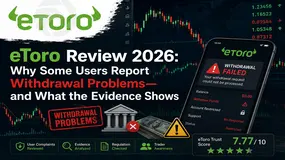
eToro, a United Kingdom-based brokerage entity, is facing serious user allegations concerning the basic facility a trader expects - Fund Withdrawal. Users worldwide are complaining about the lack of a withdrawal option, account restriction, and lack of customer support in real time. Many of their complaints appeared on credible broker review platforms such as WikiFX. In this eToro review, we have examined these complaints.

Perry Warjiyo resigned as Bank Indonesia governor, Destry Damayanti became acting governor, and the rupiah traded above Rp18,000. Here is what forex traders should monitor next.
The visible fee in an MT4 white label proposal is rarely the real cost of operating it. For an existing broker, the decision is not simply whether an MT4 white label platform is “cheap” or “expensive.” The real question is whether the commercial model remains viable after integration, support, data, client migration, compliance, and exit costs are included. That is why an MT4 white label cost review should be built as a 24- to 36-month operating case. It should compare three credible choices: 1. Keep the present MT4 setup and improve its weakest controls. 2. Replace the MT4 white label provider but retain the client proposition. 3. Migrate selected clients or products to another platform while running MT4 in parallel. This guide explains how to build that case without relying on headline prices or generic vendor claims.
WikiFXWikiFXWikiFXWikiFXWikiFXWikiFXWikiFXWikiFXWikiFXWikiFX