Abstract:Asian shares started cautiously on Monday as investors braced for a U.S. inflation report that could force another super-sized hike in interest rates, and the start of an earnings season where profits could be under pressure.
An upbeat U.S. June payrolls report already has the market wagering heavily on a rise of 75 basis points from the Federal Reserve, sending bond yields and the dollar higher.
Underlining the global nature of the inflation challenge, central banks in Canada and New Zealand are expected to tighten further this week. [NZ/INT] [CA/INT]
While Wall Street did eke out some gains last week, the market mood will be tested by earnings from JPMorgan and Morgan Stanley on Thursday, with Citigroup and Wells Fargo the day after.
“Consensus expects 2Q S&P 500 EPS (earnings per share) growth of just +6% year/year,” says Goldman Sachs analyst David J. Kostin. “While firms will likely clear this low bar, we expect cautious commentary will prompt cuts to forward estimates.”
If the economy does manage to dodge recession, Kostin sees EPS growth of 8% in 2022 and 6% in 2023, with the S&P 500 index rising to 4,300. In a moderate recession, EPS could fall by 11%.
On Monday, S&P 500 futures were down 0.4% and Nasdaq futures off 0.5%. EUROSTOXX 50 futures fell 0.6% and FTSE futures 0.7%.
Chinese blue chips lost 1.2% after Shanghai discovered a COVID-19 case involving a new subvariant, Omicron BA.5.2.1.
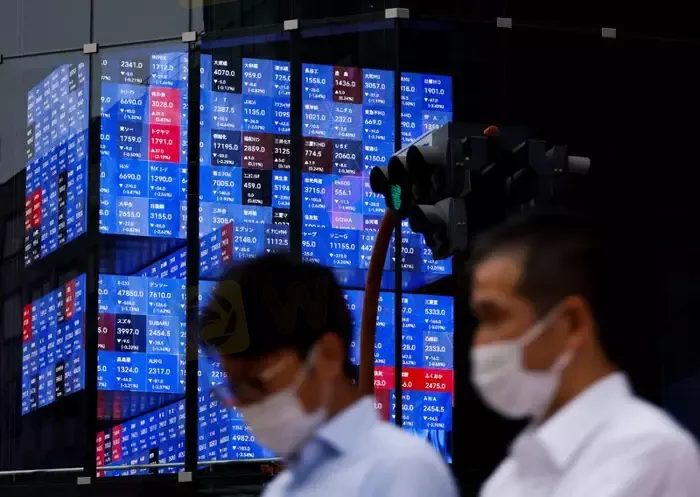
MSCI‘s broadest index of Asia-Pacific shares outside Japan slipped 0.7%. Going the other way, South Korea firmed 0.1% and Japan’s Nikkei added 1.6%.
Japans conservative coalition government was projected to have increased its majority in upper house elections on Sunday, two days after the assassination of former prime minister Shinzo Abe.
A major hurdle will be Wednesdays U.S. consumer price report, in which markets see headline inflation accelerating further to 8.8% but a slight slowdown in the core measure to 5.8%.
An early reading on consumer inflation expectations this week will also have the close attention of the Fed.
“Unexpected weakness in these releases will be required to dislodge expectations for a 75bps July 27 Fed rate rise, which lifted from about 71bps to 74bps post the payrolls report,” said Ray Attrill head of FX strategy at NAB.
Parity party
Likewise, Treasury yields climbed around 10 basis points on the jobs report and the 10-year stood at 3.09% on Monday, up from a recent low of 2.746%.
A hawkish Fed combined with fears of recession, particularly in Europe, has kept the dollar up at 20-year highs against a basket of competitors. The dollar broke above 137.00 to reach its highest since 1998 at 137.10 yen as the Bank of Japan remained dovish.
The euro continued to struggle at $1.0140, having shed 2.4% last week to hit a two-decade low and major retracement target at $1.0072.
“With little economic relief on the horizon for Europe, and U.S. inflation data likely to mark a new high for the year and keep the Fed hiking aggressively, we think the risks remain skewed in favour of the greenback,” said Jonas Goltermann, a senior markets economist at Capital Economics.
“Indeed, we think the EUR/USD rate will break through parity before long, and may well trade some way through that level.”
Rising interest rates and a strong dollar have been a headache for non-yielding gold, which was ailing at $1,740 an ounce, having fallen for four weeks in a row. [GOL/]
Oil prices also lost around 4% last week as worries about demand offset supply constraints. [O/R]
Data from China due on Friday are likely to confirm the worlds second-largest economy contracted sharply in the second quarter amid coronavirus lockdowns.
On Monday, Brent was trading 72 cents lower at $106.30, while U.S. crude eased 89 cents to $103.90 per barrel.