

Global Broker Regulation Inquiry App
About WikiFX
English
简体中文
繁體中文
English
Pусский
日本語
ภาษาไทย
Tiếng Việt
Bahasa Indonesia
Español
हिन्दी
Filippiiniläinen
Français
Deutsch
Português
Türkçe
한국어
العربية
اردو


A Forex Losing Streak Is No Time to Trust Your Gut

WikiFX
|


Abstract:A losing streak in forex triggers a stress response that can change how a trader sees the next trade. This article explains loss aversion, revenge trading, and a simple teaching model for rebuilding clear decisions.
In forex, exchange rates move in small steps called pips. A pip is the smallest standard change in price for most currency pairs, usually the fourth decimal place. A trader may follow a clear plan for weeks and still hit a losing streak. When several losses arrive together, the decision about the next trade can feel very different from the trades that came before.
 Contents
Why a Losing Streak Triggers a Stress Response
Behavioural finance uses the term loss aversion to describe a basic human pattern: the pain of a loss feels about twice as strong as the pleasure of an equal gain. This is not a character flaw. It is a normal stress response, and it can distort the next trade.
Here is a simple hypothetical example. Imagine an account of 10,000 units, say 10,000 US dollars. The plan in this example limits risk to 200 units per trade, which is 2 per cent. After a few losing trades, the balance drops to 9,000 units. That is a 10 per cent loss. To get back to 10,000 units, the new balance of 9,000 must gain about 11.1 per cent. The arithmetic gap between 10 and 11.1 is small, but it feeds the feeling that one larger trade should recover everything.
Position size, the number of currency units in a trade, decides how much each pip is worth. A stop-loss, a pre-set exit level, limits how much a trade loses. In the example, the plan keeps position size small enough that a stop-loss costs no more than 200 units. After losses, a trader may want to increase position size to win back the money. That urge has a name: revenge trading, placing a new trade mainly to recover a loss. Revenge trading is not a strategy. It is a stress response.
Self-Observation as a Circuit Breaker
Trading psychology education often teaches short observation exercises. They are not intended as therapy or personality testing. They help a trader notice whether the next decision is driven by facts or by stress.
- Body check: pause for a few seconds and notice tension in the jaw, shoulders, or stomach. Tension is a clue that stress is high.
- Name the emotion: write one word, such as 'frustrated', 'afraid', or 'desperate'. Labelling the feeling weakens its automatic pull.
- Rate the urge: estimate how strong the pull to enter a trade feels right now, on a scale from 1 to 10. A high score, around 7 or above, is a sign that emotion is leading.
- Write the story: complete the sentence 'I want to trade because...' and compare it with the original plan. If the reason has changed, the plan is no longer guiding the decision.
These exercises interrupt the stress loop before more money is placed at risk. They are not a substitute for a written trading plan.
A Five-Step Reset Model
A common teaching model is a recovery sequence. Treat this as a thought experiment, not as a personal instruction to enter the market.
- A pause. The trader steps away from charts for a defined cooling-off period, often a full day, so stress can settle.
- A label. The trader writes the dominant emotion in one or two words.
- A fact check. The trader separates facts from interpretations. 'Balance decreased by 10 per cent' is a fact. 'I must win it back quickly' is an interpretation.
- A logic review. The trader compares recent losing trades with the written criteria from before the streak. Did those trades actually match the plan?
- A risk-plan check. If the trader returns to trading, position size and stop-loss are tested against the written risk rule.
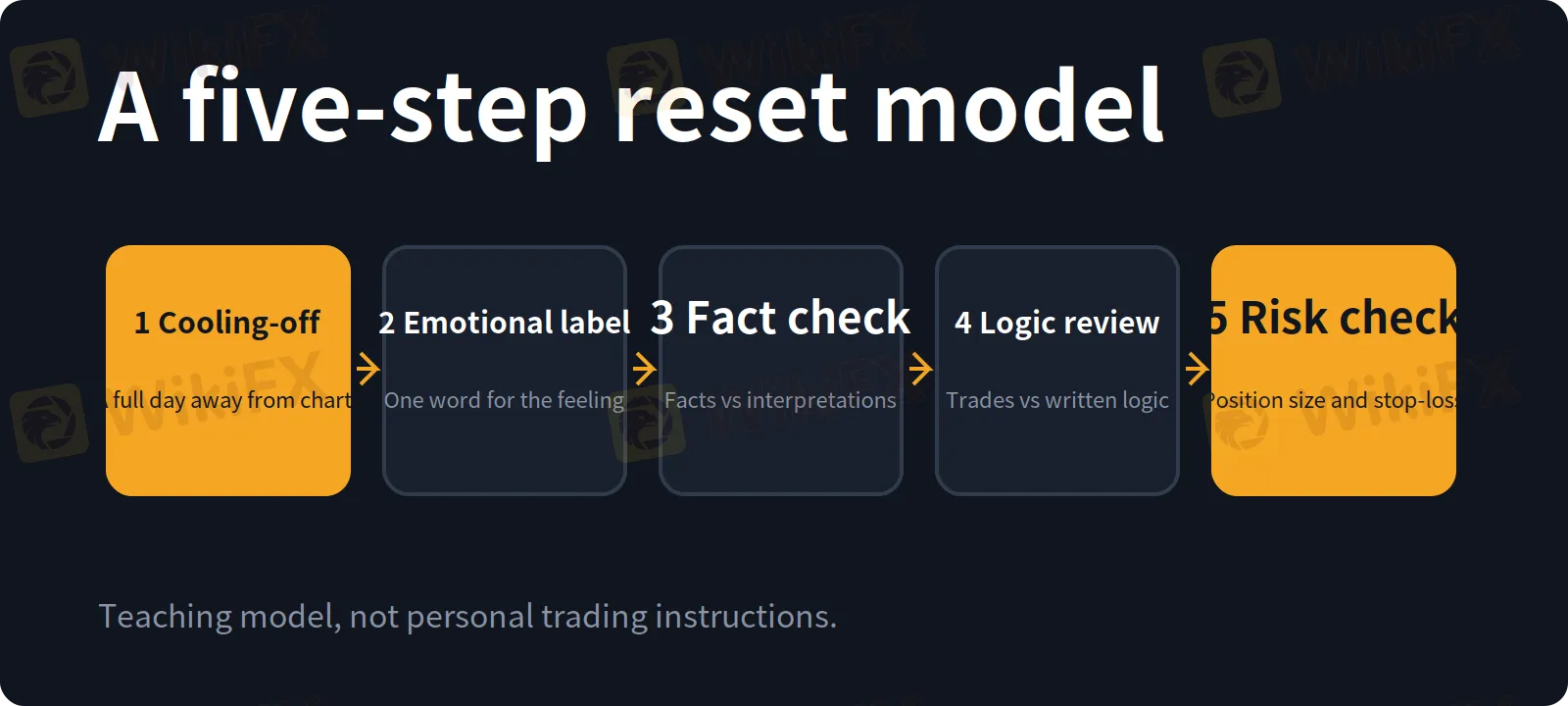
A common five-step reset for thinking after losses.
Disclaimer:
The views in this article only represent the author's personal views, and do not constitute investment advice on this platform. This platform does not guarantee the accuracy, completeness and timeliness of the information in the article, and will not be liable for any loss caused by the use of or reliance on the information in the article.
WikiFX Broker
Latest News
Exness Review 2026 for India: RBI Alert, Regulation, Login and Forex Risk
WikiFXSQUAREDFINANCIAL Review: Withdrawal Requests Go Unanswered as Clients Report Locked Accounts
WikiFXSingapore orders Facebook, Instagram, TikTok to ban scam ads
WikiFXXORKETS FX Review 2026: Withdrawal Demands and Unregulated Risks
WikiFXWarren Bowie & Smith Review 2026: Severe Withdrawal Complaints and Unregulated Risks
WikiFXDA finance chief steps aside over R4bn SARB forex probe
WikiFXAustralia dollar on longest weekly winning streak since 2020
WikiFXBessent says Treasury buyback operation could be more than $4 billion
WikiFXQuotex Review: Regulation Warnings, Broker Complaints, and Blocked Funds
WikiFXThree Losses in a Row? Rebuild Clear Decisions, Not Revenge
WikiFX