

Global Broker Regulation Inquiry App
About WikiFX
English
简体中文
繁體中文
English
Pусский
日本語
ภาษาไทย
Tiếng Việt
Bahasa Indonesia
Español
हिन्दी
Filippiiniläinen
Français
Deutsch
Português
Türkçe
한국어
العربية
اردو


Why Official and Parallel FX Rates Drift Apart

WikiFX
|


Abstract:Official and parallel exchange rates can differ sharply because the official market is often rationed. This article explains the gap, walks through a hypothetical premium calculation, and separates what the gap measures from what it cannot predict.
 Contents
What the two rates measure
Every foreign exchange rate is the price of one currency in terms of another. A country can show two very different prices at the same moment. The official rate is the price published or defended by a central bank, typically used for some imports, government transactions, and recorded statistics. The parallel market rate is the price set where buyers and sellers actually meet outside those official channels.
Beginners often assume one rate is fake and the other is real. A better way is to see them as two separate markets with different rules, supply, and access. The gap between them is not a printing error; it is information about how tight or open the currency regime is. This gap is also not the same as a normal bid-ask spread at a broker or bank. A bid-ask spread is the small difference between buying and selling prices in one market, while the official-versus-parallel gap is a difference between two whole market prices. In some countries the parallel market is a licensed bureau de change; in others it is unlicensed but tolerated. Legal status differs, but the economic logic is the same.
The gap tells you about pressure and restriction, not about what to buy or sell.
Why the gap appears
When a central bank tries to keep its currency stronger than private demand would support, it must ration foreign exchange. Not everyone who wants dollars or euros at the official price can get them. Those who cannot go to the parallel market and pay more.
Key causes:
- Official supply is limited: the central bank may release foreign currency only for medicine, fuel, or approved imports.
- Demand exceeds official supply: importers, students abroad, and savers may all want foreign currency at the same time.
- Controls create queues: approvals, documentation, or waiting lists push people to informal dealers.
- Inflation expectations: if local prices are rising quickly, people prefer to hold foreign currency, raising parallel demand.
- Risk and transaction cost: informal dealers charge for the legal or operational risk they bear.
- No single clearing price: official channels clear at a controlled price, while the parallel market clears by supply and demand.
A central bank can defend an official rate by selling from its reserves, imposing surrender requirements on exporters, or setting allocation rules. Each of these limits how much foreign currency reaches the market at the official price, so a parallel price emerges. The size of the gap is not random. It reflects how much unmet demand is being pushed outside the official system.
The parallel premium formula and a worked example
The simplest measure of the gap is the parallel market premium. It is calculated this way:
Parallel premium in percent equals (parallel rate divided by official rate, minus one) multiplied by one hundred.
For a clearly hypothetical example, imagine a country where the central bank publishes an official rate of 60 local currency units per US dollar. In the informal market, the same dollar changes hands at 90 local units.
The parallel premium is calculated in three steps:
- Divide the parallel rate by the official rate: 90 / 60 = 1.5
- Subtract one: 1.5 - 1 = 0.5
- Multiply by one hundred to express it as a percentage: 50 percent
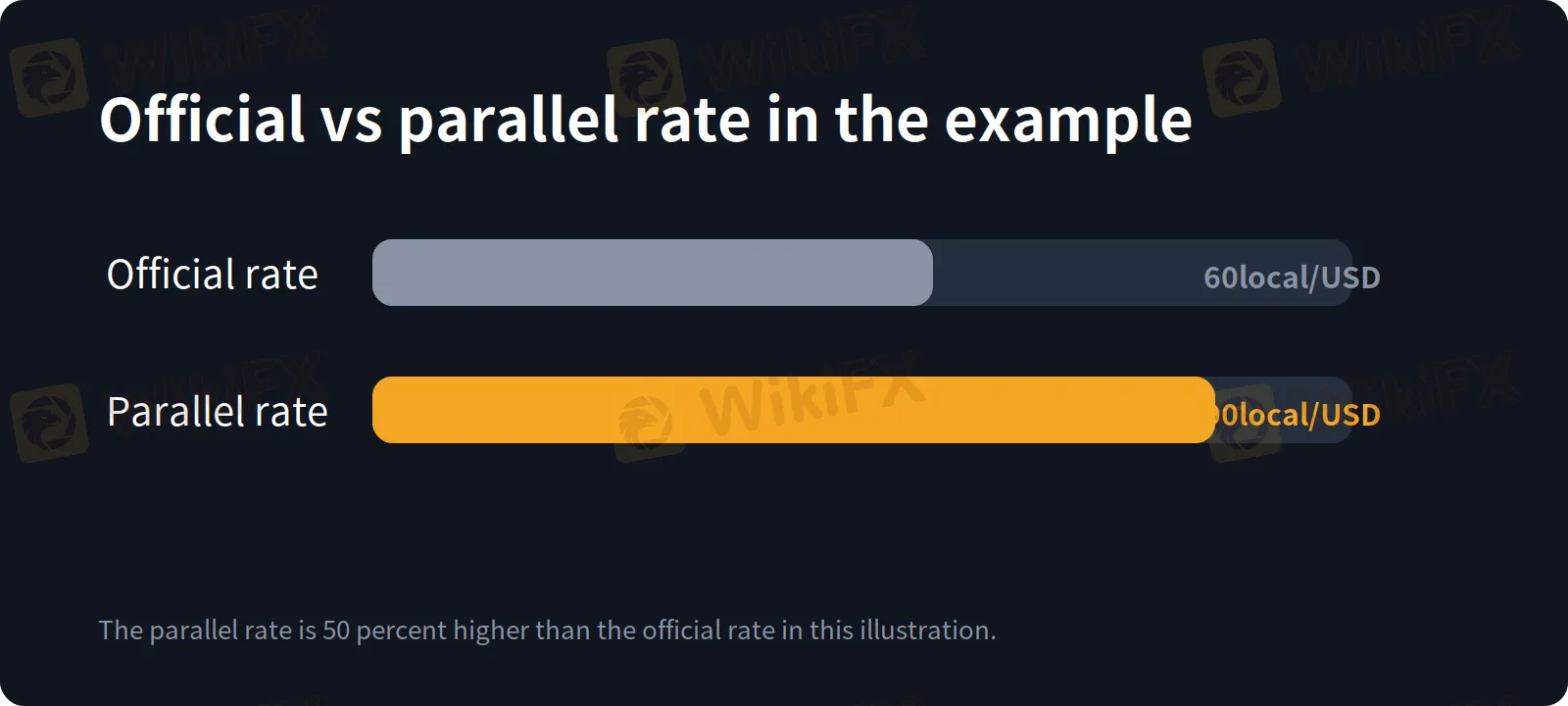
Hypothetical numbers only; they are not real market quotes.
Common beginner mistakes
New traders often read too much into a gap. A wide gap can mean the local currency is under pressure, but it does not tell you which way a forex pair will move next. The official rate may stay unchanged for months while the parallel rate moves every day, so using the official rate alone can hide real price changes.
Also, the gap is not a free profit opportunity for ordinary converters. You may not be able to buy at the official rate, and selling at the parallel rate can involve legal, timing, and counterparty risks. A high premium can also reflect a shortage of official dollars rather than a precise future price.
Another error is comparing gaps across countries without knowing their regimes. A 20 percent premium in one country may be very different from 20 percent in another because reserve levels, export structures, and capital controls differ. A more useful way to use the gap is as a diagnostic number, not a signal. It tells you how much pressure there is on official supply and how restrictive the currency regime has become. It does not tell you to buy or sell.
Disclaimer:
The views in this article only represent the author's personal views, and do not constitute investment advice on this platform. This platform does not guarantee the accuracy, completeness and timeliness of the information in the article, and will not be liable for any loss caused by the use of or reliance on the information in the article.
WikiFX Broker
Latest News
Review 2026: XORKETS FX Withdrawal Complaints and Unregulated Risk
WikiFXStoneX Agrees to Acquire Brazil FX Bank Banco Travelex
WikiFXReview 2026: GFS Withdrawal Complaints, Regulation Gaps, and Broker Risk Signals
WikiFXPlus500 Joins Bahamas Forex and CFD Industry Association
WikiFXMalaysian Doctor Loses RM558,000 to Forex-Crypto Scam
WikiFXGold Climbs Toward $4,400 as September Fed Hike Odds Tumble
WikiFXVG Markets Review: A Real FSCA Licence, But Why Only a 4.47 Score?
WikiFXTenTrade Review 2026: Complaints, Withdrawals, and Risk Signals
WikiFXadmiral Review 2026: Clone Warnings, Withheld Profits, and Withdrawal Risks
WikiFXTriumphFX Review: Revoked Licence and TFX Token Losses Warrant Caution
WikiFX