

Global Broker Regulation Inquiry App
About WikiFX
English
简体中文
繁體中文
English
Pусский
日本語
ภาษาไทย
Tiếng Việt
Bahasa Indonesia
Español
हिन्दी
Filippiiniläinen
Français
Deutsch
Português
Türkçe
한국어
العربية
اردو


What is Forex? A Beginner’s Guide to the Global Currency Market

WikiFX
|


Abstract:This beginner-friendly guide explains the structure of the foreign exchange market, how currency pairs are quoted, the mechanics of spreads and leverage, and the risks involved. Through a step-by-step hypothetical trade, you'll see how leverage affects both profit and loss. The article also corrects common misconceptions, such as the belief that forex is a quick route to wealth.

 Contents
What is Forex?
Many newcomers first hear about forex and picture fast cars and overnight wealth. In reality, the foreign exchange market is the worlds largest and most liquid financial market, with over $9 trillion traded every day. It operates 24 hours a day, linking central banks, commercial banks, corporations, and individual traders across the globe. But it is not a shortcut to riches, it demands learning, discipline, and risk management.
The forex market (FX) is where currencies are exchanged. Think of it as a global network: you might need euros for a holiday, while a Japanese car maker needs dollars to buy parts. These participants swap one currency for another, creating a marketplace that never sleeps. Unlike a stock exchange, forex has no central location, it runs electronically over-the-counter (OTC), with key trading centres in London, New York, Tokyo, and other major cities.
Key participants include:
- Central banks: they manage national reserves and influence exchange rates.
- Commercial and investment banks: they facilitate client transactions and trade for their own accounts.
- Corporations: they hedge currency risk from international trade.
- Retail traders: individuals like you who aim to profit from rate changes.
When you trade forex electronically, you do not take delivery of physical cash. You simply agree to exchange one currency for another at a given price, later reversing the trade to capture a gain or loss.
How Currency Pairs and Quotes Work
In forex, currencies are traded in pairs. The first currency is the base currency, and the second is the quote currency. For EUR/USD, the euro is the base and the US dollar is the quote. A price of 1.1535 means 1 euro costs 1.1535 US dollars.
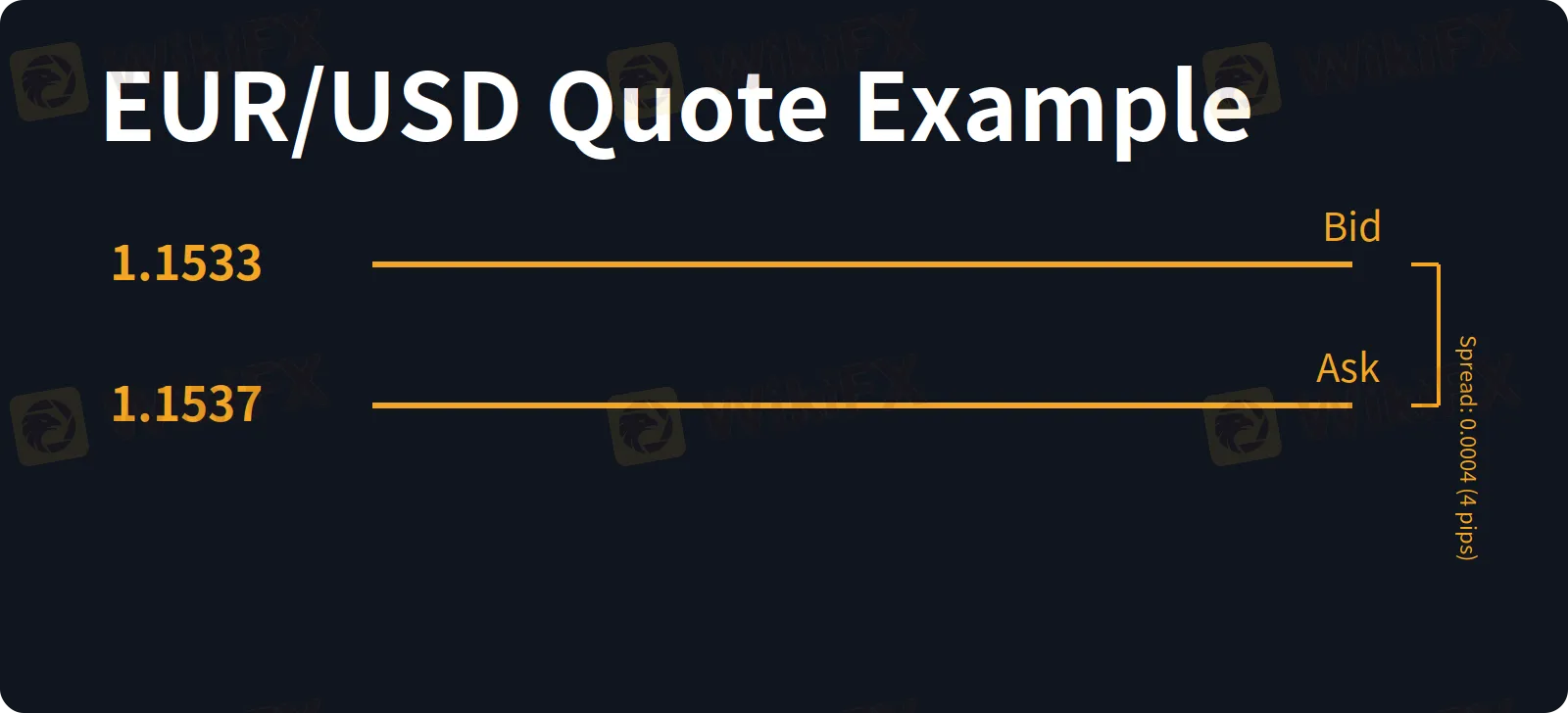
On a trading platform, you always see two prices: a bid and an ask. The bid is the price at which the market (or your broker) will buy the base currency from you. The ask is the price at which the market will sell the base currency to you. The difference between them is the spread, usually measured in pips. A pip is typically the fourth decimal place for most major pairs, so a spread of 0.0004 equals 4 pips.
Hypothetical example: Suppose you see EUR/USD quoted as:
- Bid: 1.1533
- Ask: 1.1537
The spread is 0.0004 (4 pips). If you want to buy (go long), you enter at the ask price of 1.1537. If you immediately sold at the bid of 1.1533, you would lose the spread. In this market, you need the price to move in your favour by more than the spread to make a profit.
Leverage and Margin: Amplifying Your Trade
Forex brokers offer leverage, which lets you control a larger position with a smaller amount of money. It is expressed as a ratio, such as 1:100. This means that for every $1 in your account, you can trade $100 in the market. The deposit you must put down is called margin.
Here is a clearly hypothetical calculation to show how leverage, margin, and profit or loss work together:
- You decide to buy one micro lot of EUR/USD. One micro lot is 1,000 units of the base currency, so the notional value is 1,000 × 1.1535 (the market rate) = $1,153.50.
- With 1:100 leverage, your required margin is $1,153.50 / 100 = $11.54 (rounded).
- You enter at the ask price 1.1537, expecting the euro to strengthen.
- Later, the pair is quoted at 1.1553 (bid) / 1.1557 (ask). You close the trade by selling at the bid 1.1553. Your profit in pips = 1.1553 – 1.1537 = 0.0016, or 16 pips.
- One pip for a micro lot on EUR/USD is about $0.10. So your profit is 16 × $0.10 = $1.60.
Leverage magnifies both gains and losses. If the price had moved against you by 16 pips, you would have lost $1.60, which is well over 10% of your margin. This illustrates how even a small adverse move can seriously erode your account if you do not manage risk properly.
Common Beginner Misunderstandings
- Forex is not a path to overnight wealth. Many online advertisements promise quick riches, but sustainable trading requires education, practice, and a disciplined approach. Treat forex as a skill, not a lottery.
- High leverage is a double-edged sword. Some brokers offer ratios as high as 1:500. While tempting, using such leverage can wipe out your account in seconds if the market moves against you. Always use leverage cautiously, and never risk money you cannot afford to lose.
- The spread always costs you. Every trade starts with a loss equal to the spread. This is why frequent trading with a tight strategy can be eroded by transaction costs. Look for competitive spreads, but never sacrifice regulatory safety for a lower spread.
- Forex is not just speculation. Central banks and corporations use the forex market for practical needs: stabilising their currency, paying foreign bills, or hedging future income. Understanding this larger picture helps you appreciate that the market is far more than a casino.
Remember, forex is a market where currencies are bought and sold. It is not a guaranteed income source or a magic system. Learning its mechanics, from pips and lots to leverage and margin, is the first step toward becoming an informed participant. Continue your education with us at WikiFX, where our goal is to give you knowledge, not trading advice.
Disclaimer:
The views in this article only represent the author's personal views, and do not constitute investment advice on this platform. This platform does not guarantee the accuracy, completeness and timeliness of the information in the article, and will not be liable for any loss caused by the use of or reliance on the information in the article.
WikiFX Broker
Latest News
Exness Review for Indian Traders 2026: The RBI Question Comes Before Leverage and Spreads
WikiFXEMAR MARKETS Review 2026: Severe Withdrawal Complaints and Risk Signals
WikiFXTrader's Way Review: Trades Vanished Overnight , And There's No Regulator to Call
WikiFXLockwood Review: AMF-Blacklisted Broker with Users Reporting Blocked Withdrawals
WikiFXBYBIT Review: What Traders Should Know Before Depositing
WikiFXPocket Broker Review: What Traders Should Know Before Depositing
WikiFXIC Markets Global Review for South Asian Traders: A Global License Isn't the Same as Local Permit
WikiFXTraze Review: What Traders Should Know Before Depositing
WikiFXMatch-Trade Gives AI Direct Access to Broker Trading APIs
WikiFXWhy Sovereign Debt Can Sink a Currency: The Credit Risk Channel
WikiFX