

Global Broker Regulation Inquiry App
About WikiFX
English
简体中文
繁體中文
English
Pусский
日本語
ภาษาไทย
Tiếng Việt
Bahasa Indonesia
Español
हिन्दी
Filippiiniläinen
Français
Deutsch
Português
Türkçe
한국어
العربية
اردو


The Danger of Chart Fatigue: How Tired Forex Traders Fall for Sunk Costs and Herd Panic

WikiFX
|


Abstract:Staring at Forex charts for too long drains a trader's mental energy, leading to "decision fatigue." This article explains how exhausted beginners can fall into psychological traps like the sunk cost fallacy, blindly following market sentiment, and making emotional choices instead of relying on technical reality.
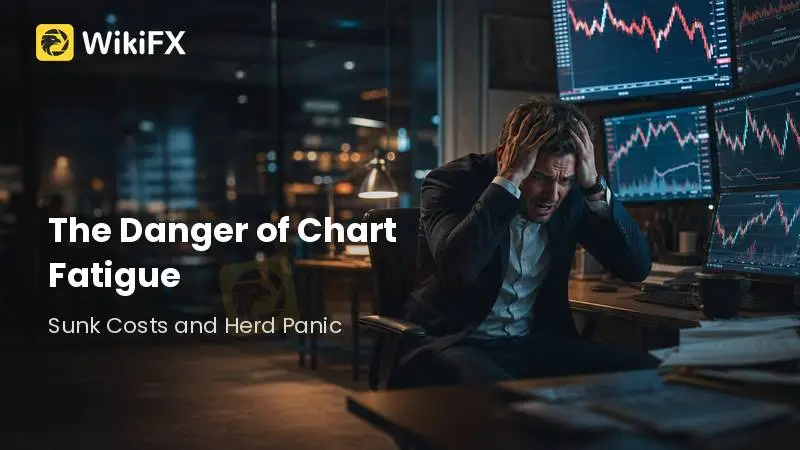
Many Indian retail beginners trade Forex during the busy evening hours when the London and New York sessions overlap. Staring at moving exchange rates and flashing indicators late into the night can quickly exhaust your brain. In behavioral psychology, this is known as decision fatigue.
When your mental energy drains, your trading discipline breaks down. You stop reading the market clearly and start making emotional choices driven by fear, greed, or frustration.
Instead of treating technical analysis as a tool to measure probability, a tired trader uses it to justify bad decisions. Based on the provided concepts of behavioral economics and market sentiment, here is why a fatigued mind damages your trading account and how to prevent it.
 Contents
The Trap of Technical Analysis Overload
Many technical analysts believe market information is largely reflected in price action. Traders use tools like candlesticks, moving averages, momentum indicators, or the Elliott Wave theory to anticipate where prices might go.
However, overanalyzing these tools causes extreme mental fatigue. An exhausted trader might spend hours trying to count the exact five impulse waves and three corrective waves of an Elliott Wave pattern. They might clutter their screen with excessive indicators like the Relative Strength Index (RSI), moving averages, and MACD.
When you track too much data for too long, your brain struggles to process the noise. You lose sight of the primary trend. This fatigue forces you to abandon your original trading plan and react purely to short-term price jumps.
The Sunk Cost Fallacy in Forex
One of the most dangerous side effects of decision fatigue is falling for the sunk cost fallacy. A sunk cost is an expense—whether time, money, or effort—that has already been lost and cannot be recovered.
In Forex trading, margin tied up in a heavily losing position is often a sunk cost. Rational decision-making dictates that you should cut your losses if the market structure changes. However, humans suffer from loss aversion. We feel the pain of a loss much more intensely than the joy of a gain.
When you are mentally tired, commitment bias kicks in. You refuse to close a losing USD/INR or EUR/USD trade simply because you have already invested so much time watching it and so much margin keeping it open. Instead of looking at the actual market data, you hold on to the false hope that the situation will turn around. This failure to acknowledge a loss often leads to wiped-out accounts.
Shifting from “Positive” to “Normative” Thinking
In economics, there is a strict difference between positive statements and normative statements. Positive economics looks at objective, measurable facts. Normative economics looks at what “should” or “ought” to happen based on feelings or value judgments.
When a beginner has severe chart fatigue, they stop trading positive facts and start trading normative hope.
A rested trader looks at the chart and says, “The 50-day moving average just crossed below the 200-day moving average. This is a bearish signal, so I will exit my buy position.” This is a positive, fact-based observation.
A tired, stressed trader looks at the exact same chart and says, “The price has dropped too much today. It must go back up. It should recover by tomorrow.” This is normative thinking. The market does not care what you think should happen, and trading based on what a currency pair “ought” to do is a quick way to lose money.
Blindly Following Market Sentiment
Market sentiment is the overall mood of investors regarding a specific currency or the broader financial market. When prices rise, the sentiment is bullish. When prices fall, the sentiment is bearish.
Under normal circumstances, understanding the “wisdom of crowds” can be helpful. A large, diverse group of independent market participants generally prices an asset efficiently. However, when traders are fatigued and panicked, the wisdom of the crowd turns into a dangerous herd mentality.
When the market drops suddenly, exhausted traders stop analyzing. They look at what everyone else is doing on social media or in chat groups and simply copy the panic. The crowd is easily swayed by short-term news, rumors, or the fear of missing out. Following the herd during a sentiment-driven meltdown often leads traders to enter or exit at poor prices.
The Practical Takeaway Before Placing a Trade
Avoiding decision fatigue requires strict rules that do not require deep thinking in the heat of the moment.
First, focus on future returns, not past investments. If you are stuck in a bad trade, ask yourself: “If I did not already have an open position, would I buy this currency pair right now?” If the answer is no, close the trade.
Second, set hard limits. Decide your maximum stop-loss before you click buy or sell. If your trade hits that limit, walk away from the screen for the night.
Finally, do not let an aggressive broker force you into making fatigued decisions. Sometimes, when stuck in a deep drawdown, a platform account manager might call you to demand more deposits to “save” your trade. Throwing new money at a bad position is the ultimate sunk cost trap. If a broker pressures you into depositing more funds to avoid a margin call, take a step back. Beginners can always use tools, such as WikiFX, to verify a brokers license and regulatory background before risking more capital in a state of panic.
Disclaimer:
The views in this article only represent the author's personal views, and do not constitute investment advice on this platform. This platform does not guarantee the accuracy, completeness and timeliness of the information in the article, and will not be liable for any loss caused by the use of or reliance on the information in the article.
WikiFX Broker
Latest News
Exness Review for Indian Traders 2026: The RBI Question Comes Before Leverage and Spreads
WikiFXEMAR MARKETS Review 2026: Severe Withdrawal Complaints and Risk Signals
WikiFXTrader's Way Review: Trades Vanished Overnight , And There's No Regulator to Call
WikiFXLockwood Review: AMF-Blacklisted Broker with Users Reporting Blocked Withdrawals
WikiFXBYBIT Review: What Traders Should Know Before Depositing
WikiFXPocket Broker Review: What Traders Should Know Before Depositing
WikiFXIC Markets Global Review for South Asian Traders: A Global License Isn't the Same as Local Permit
WikiFXTraze Review: What Traders Should Know Before Depositing
WikiFXMatch-Trade Gives AI Direct Access to Broker Trading APIs
WikiFXWhy Sovereign Debt Can Sink a Currency: The Credit Risk Channel
WikiFX