

Global Broker Regulation Inquiry App
About WikiFX
English
简体中文
繁體中文
English
Pусский
日本語
ภาษาไทย
Tiếng Việt
Bahasa Indonesia
Español
हिन्दी
Filippiiniläinen
Français
Deutsch
Português
Türkçe
한국어
العربية
اردو


Why Your Forex Trade Executed at the Wrong Price

WikiFX
|


Abstract:A clear explanation for beginner Forex traders on what slippage is, why market orders cause your entry price to differ from the screen, and how broker types (A-Book vs B-Book) influence trade execution. The takeaway advises using limit orders to control pricing and verifying broker reliability to avoid artificial slippage.
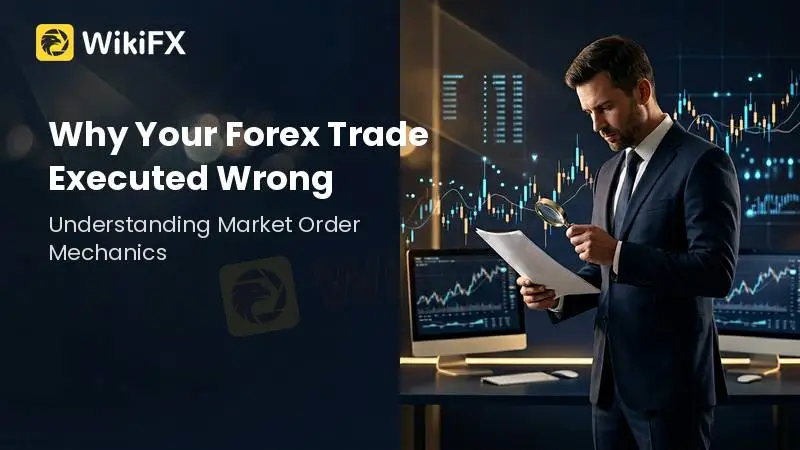
It is a scenario every new Forex trader experiences: you watch a chart, wait for the perfect moment, and tap “Buy” when the numbers look right. But when you check your open positions a second later, you realize your trade entered at a completely different—and usually worse—price.
This frustrating gap between the price you expected and the price you actually received is called slippage. It often leaves beginners wondering if their broker is cheating them or if the trading platform has frozen. While bad brokers certainly exist, slippage is primarily a normal function of how live markets process your instructions. Understanding the mechanics behind it can help you regain control over your entries.
 Contents
The Reality of Market Orders
When you click “Buy” or “Sell” without setting specific price boundaries, you are using what is known as a Market Order. This instruction tells the trading platform to execute your trade immediately at the best available price.
A market order prioritizes speed over precision. In a fast-moving market, currency prices update several times a second. By the time your order travels from your device to the market, the original price you saw on screen may no longer exist. The system simply grabs the next available price to ensure you get into the trade.
If a major economic news event was just released, or if the market lacks trading volume (liquidity), the gap between the screen price and the executed price can be noticeably wide. This is natural slippage.
How Your Broker's Setup Affects the Gap
The way your broker handles your trades also dictates how and why your prices slip. Market structure generally falls into two models:
A-Book Brokers: These brokers pass your trades directly to the open market or external liquidity providers. Slippage is a natural outcome here because your order must be matched with real buyers and sellers. You get true market pricing, which is highly transparent, but during volatile spikes, price slippage is simply unavoidable.
B-Book Brokers: In this model, the broker processes your trades internally and acts as the counterparty to your position. This means your loss could be their profit, creating a potential conflict of interest. While properly regulated B-Book brokers operate fairly and often provide cost-effective execution for smaller accounts, shady platforms abuse this system. Unregulated B-Book brokers might deliberately manipulate prices, delay your trades, or force artificial slippage to ensure you start your trade at a disadvantage.
Two Ways to Protect Your Entry Price
If you want to avoid the frustration of starting a trade deep in the negative due to a slipped price, you can adjust your order strategy.
Limit Orders (限价委托): Instead of accepting whatever price is available right now, a Limit Order tells the system to open your trade only at a specific price or better. The trade-off is speed and absolute certainty of entry. If the market never reaches your required limit, your trade simply will not execute.
Fill or Kill Orders (FOK): Designed for high price sensitivity, this is an all-or-nothing instruction. A FOK order demands that your entire trade volume is filled immediately at your requested price. If the market cannot match those exact conditions in that split second, the entire order is cancelled. This prevents you from getting trapped in unwanted prices when the market is fluctuating wildly.
The Practical Takeaway
Slippage is not automatically a sign that you are being scammed. It is the real-world cost of demanding immediate entry into a lively market. If precise entry pricing matters more to your strategy than simply being in the trade, it is time to switch from market orders to limit orders.
However, if you consistently face massive slippage during normal, calm market hours, your platform might be intentionally delaying your execution. Before attempting to deposit more funds to cover losses, use the WikiFX app to check your broker. Verifying their regulatory licenses and reading other user reviews regarding persistent slippage will quickly tell you if you are dealing with normal market mechanics or a problematic broker manipulating your trades.

Disclaimer:
The views in this article only represent the author's personal views, and do not constitute investment advice on this platform. This platform does not guarantee the accuracy, completeness and timeliness of the information in the article, and will not be liable for any loss caused by the use of or reliance on the information in the article.
WikiFX Broker
Latest News
Xin Synergy Escalates Probe Into Former Directors Over Moneylending Operations
WikiFXMalaysia: Hawkish pause keeps options open – DBS
WikiFXFCA Warns Against Multiple Unauthorised Forex Brokers
WikiFXRM6 Million Crypto Windfall Vanishes In Three Days
WikiFXAUD/JPY Price Forecast: Rebounds above 112.50, while staying constrained below 100-day SMA
WikiFXLOTAS CAPITAL Review 2026: MISA Record Discrepancy and Recent Withdrawal Complaints
WikiFXLeading the Transparency Movement: The Trust Dialogue with Nikos Christou from Lirunex
WikiFXMalaysian Ringgit: BNM hawkish tilt supports MYR – Commerzbank
WikiFXFormer Banker Gets Seven Years After RM1.58 Million Client Fraud
WikiFXEUR/USD holds 1.15661 to the pip - reclaim or fade?
WikiFX