Abstract:When looking at a broker, the first question is always about safety. Is Dbinvesting a safe platform for your investments? The immediate answer is complicated and requires extreme caution. While Dbinvesting is officially a regulated company, its license comes from the Seychelles Financial Services Authority (FSA), which is classified as an offshore regulator. This difference is important and forms the basis of the high-risk status connected to this broker.
This initial concern is made worse by objective, third-party data. As of our 2026 review, Dbinvesting holds an extremely low WikiFX safety score of just 2.14 out of 10. This score is not random; it is a data-based reflection of the broker's weak regulation, lack of transparency, and most importantly, its track record with clients. The platform has been flagged for a large number of serious user complaints, which show a disturbing pattern of issues, especially concerning withdrawing funds and the random cancellation of profits.
The pu
An Immediate Safety Check
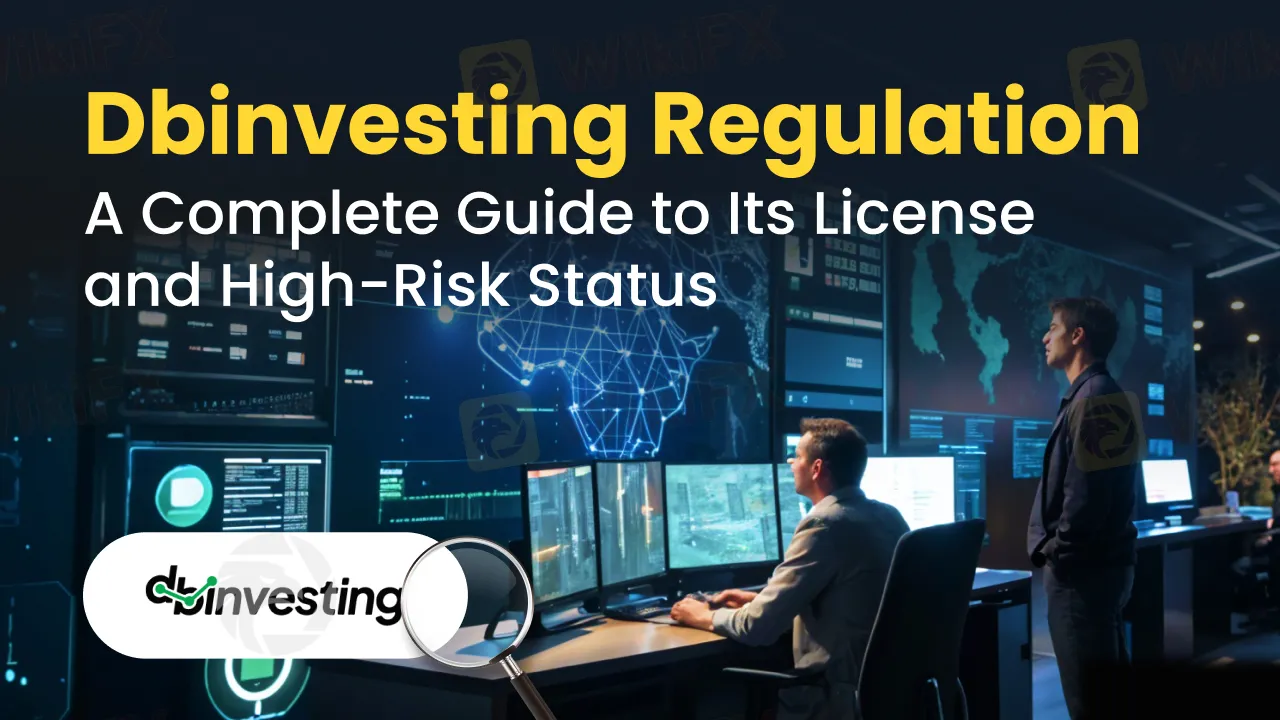
When looking at a broker, the first question is always about safety. Is Dbinvesting a safe platform for your investments? The immediate answer is complicated and requires extreme caution. While Dbinvesting is officially a regulated company, its license comes from the Seychelles Financial Services Authority (FSA), which is classified as an offshore regulator. This difference is important and forms the basis of the high-risk status connected to this broker.
This initial concern is made worse by objective, third-party data. As of our 2026 review, Dbinvesting holds an extremely low WikiFX safety score of just 2.14 out of 10. This score is not random; it is a data-based reflection of the broker's weak regulation, lack of transparency, and most importantly, its track record with clients. The platform has been flagged for a large number of serious user complaints, which show a disturbing pattern of issues, especially concerning withdrawing funds and the random cancellation of profits.
The purpose of this deep dive is to move beyond the simple “yes/no” of regulation and explain what the Dbinvesting regulation truly means for your capital. We will analyze the license itself, the built-in risks of its offshore status, and the real-world consequences as documented by traders who have shared their experiences. Before depositing any funds, it's important to see the full picture. You can view Dbinvesting's complete profile, including its low score and all user alerts, directly on its WikiFX page.
The Official License Details
To conduct a thorough analysis, we must first establish the facts on paper. The legal and regulatory framework for Dbinvesting is based on a single offshore license. It is important for traders to understand these specifics, as they form the foundation for assessing the broker's legitimacy.
Here are the official details of the Dbinvesting license, as verified by public records:
· Licensed Entity: DB Invest LIMITED
· Regulatory Authority: Seychelles Financial Services Authority (FSA)
· License Type: Derivatives Trading License (EP)
· License Number: SD053
· Status: Offshore Regulated
These details confirm that DB Invest LIMITED is legally allowed by the Seychelles FSA to offer derivatives trading services. However, this is where the verification for many traders mistakenly ends. The existence of a license is only the starting point. The real measure of security comes from the strength, jurisdiction, and enforcement power of the regulatory body that issued it. The Seychelles FSA license places Dbinvesting firmly in the high-risk category of offshore-regulated brokers, a classification that has serious implications for the safety of your funds.
What Offshore Regulation Means
The term “regulated” can be misleading if not properly qualified. There is a huge difference in the level of protection offered by a top-tier regulator versus an offshore one. The Dbinvesting license from the Seychelles FSA falls squarely into the latter category. Understanding this difference is the single most important piece of research a potential investor can perform.
Top-tier regulators, such as the UK's Financial Conduct Authority (FCA) or the Australian Securities and Investments Commission (ASIC), operate within strong legal frameworks in major financial economies. They impose strict requirements on brokers for capital adequacy, client fund separation, and operational transparency. Most importantly, they provide powerful recourse mechanisms for clients.
Offshore regulators, such as the Seychelles FSA, are often characterized by more lenient requirements, lower capital demands, and significantly weaker enforcement capabilities. They are attractive to brokers seeking to minimize operational costs and regulatory scrutiny, but this comes at a direct cost to trader protection.
To illustrate the critical differences, consider the following comparison:
When you trade with Dbinvesting, you are operating under the right-hand column. While a Dbinvesting license technically exists, it provides none of the meaningful protections that traders in well-regulated jurisdictions take for granted. There is no compensation scheme, no independent ombudsman, and a regulator with limited power to intervene effectively on your behalf if a dispute arises.
A Pattern of Complaints
Theoretical risks associated with offshore regulation become real when we examine a broker's history with its clients. The numerous complaints filed against Dbinvesting on platforms like WikiFX are not random, isolated incidents. Instead, they reveal a consistent and alarming pattern of behavior, primarily targeting traders who become profitable. The evidence suggests a business model that may welcome deposits and tolerate losses but actively blocks and penalizes success.
We have analyzed the detailed exposure reports to identify the core themes of these complaints.
Theme 1: The “Bonus Abuse” Clause to Erase Profits
A recurring tactic reported by users is the use of vague, internal clauses to justify the confiscation of profits. Traders report operating without issue until they attempt to withdraw significant earnings, at which point the broker retroactively accuses them of “bonus abuse” or other rule violations.
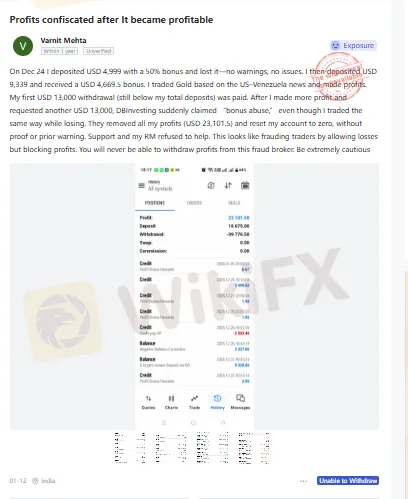
A stark example is the case of user Varnit Mehta from India. After an initial losing deposit, he funded his account again with over $9,000. Through successful trading, he grew his account and made a successful withdrawal. However, when he attempted a second withdrawal after accumulating further profits, Dbinvesting abruptly erased over $23,000 in profits, citing “bonus abuse.” The trader noted that his trading strategy had not changed from when he was losing, and the broker provided no prior warnings or concrete proof of the alleged violation.
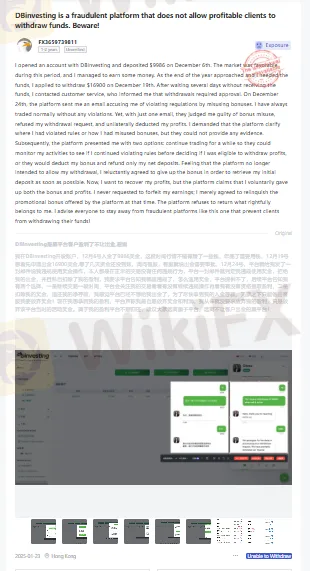
This was not an isolated event. Another user from Hong Kong (FX3659739811) reported a nearly identical experience. After earning profits and applying for a withdrawal of $16,900, the platform accused him of misusing bonuses, refused the withdrawal, and unilaterally deducted his profits without providing any evidence of wrongdoing.
Theme 2: Obstruction and Rejection of Withdrawals
Another common theme is the erection of insurmountable barriers when profitable clients attempt to access their funds. The reasons provided by the broker often appear to be shifting and pretextual.
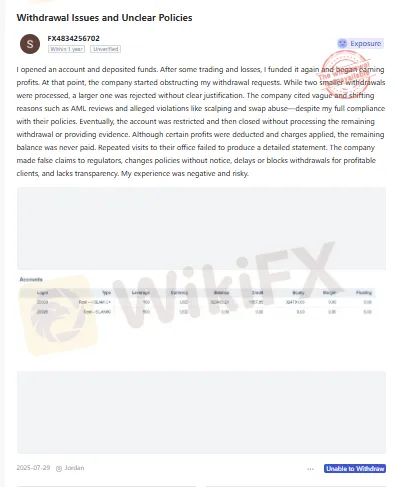
A trader from Jordan (FX4834256702) documented a clear case of this. After funding his account and becoming profitable, his withdrawal requests were repeatedly obstructed. The broker cited a series of changing reasons, from “AML reviews” to unsubstantiated claims of “scalping” and “swap abuse.” This escalation of accusations culminated in the broker closing the trader's account entirely without processing the final withdrawal, effectively confiscating his remaining balance.
Theme 3: Lack of Transparency and Evidence
A unifying thread across these serious complaints is Dbinvesting's consistent failure to provide any concrete evidence to back up its allegations. When challenged by traders to prove the “bonus abuse” or “scalping,” the broker reportedly defaults to silence or simply reiterates the accusation. This lack of transparency makes it impossible for traders to defend themselves and reinforces the perception that these clauses are being used as tools to arbitrarily seize client profits. This behavior is a hallmark of high-risk brokers operating with the impunity that weak, offshore regulation provides.
These are just summaries of the detailed accounts. We strongly encourage traders to read the full, firsthand reports in the Exposure section on the Dbinvesting WikiFX page to understand the severity of these claims.
Corporate Footprint Mismatches
A trustworthy broker maintains a transparent and verifiable corporate structure. Scrutinizing a company's physical presence versus its on-paper registration is a key research step. In the case of Dbinvesting, this investigation reveals significant discrepancies that add another layer of risk.
The WikiFX field survey team conducted on-site visits to the addresses associated with Dbinvesting and its related entities. The findings highlight a mismatch between the broker's corporate web and its tangible, real-world operations.
· Seychelles: The official registered address is Room B11, First Floor, Providence Complex, Providence, Mahe. WikiFX Finding: An office was found at this location. This is expected, as it is the address required for its offshore license.
· Cyprus: Dbinvesting is linked to a Cyprus-based company named ENIGMA081 LTD. Cyprus is a major hub for financial services. WikiFX Finding: No Physical Presence Found. The inability to verify an operational office in a key declared location, such as Cyprus, is a major red flag. It suggests the entity may be a shell company used for registration purposes, not a substantive operational center.
· Egypt: The broker is also linked to “DB Investing Egypt.” WikiFX Finding: No Physical Presence Found. Similar to the Cyprus finding, the lack of a verifiable office in a region where it claims to operate undermines its credibility.
This lack of a verifiable physical footprint in key operational areas is deeply concerning. Furthermore, Dbinvesting is connected to a complex network of related companies in various jurisdictions, including DB PAY LTD in Canada and DB HOLDING GROUP LLC in the United States. This convoluted international structure, combined with a lack of physical presence, creates an opaque operational environment. It makes it difficult for clients to determine who they are truly dealing with and where accountability lies, further increasing their risks.
The Final Risk Verdict
After a comprehensive analysis of the Dbinvesting regulation, user history and corporate structure, the conclusion is clear and unambiguous. Trading with Dbinvesting represents an unacceptably high level of risk to your capital. The broker exhibits multiple critical warning signs that should not be ignored by any potential investor.
Let's synthesize the key findings into a final risk assessment:
· Weak Offshore Regulation: The primary Dbinvesting license is from the Seychelles FSA. As we have detailed, this offshore regulation provides minimal trader protection, lacks a client compensation fund, and offers no meaningful recourse in the event of a dispute.
· Documented Pattern of Harm: There is substantial, evidence-based reporting from multiple clients that details a consistent pattern of profit cancellation and withdrawal obstruction. The broker has repeatedly used vague clauses, such as “bonus abuse”, to confiscate earnings from successful traders.
· Questionable Operations: The company's physical presence does not align with its sprawling corporate network. The failure to substantiate offices in key declared locations, such as Cyprus and Egypt, points to a lack of operational transparency and substance.
· Extremely Low Trust Score: All of these factors culminate in an exceptionally low WikiFX safety score of 2.14/10. This score serves as a clear, data-driven summary of the immense risks identified throughout our 2025 investigation.
Based on this overwhelming evidence, the potential for financial loss when dealing with Dbinvesting far outweighs any perceived benefits such as bonuses or high leverage. The broker's conduct is consistent with that of an untrustworthy, high-risk operation that poses a direct threat to client funds. We strongly advise traders to avoid this platform.
Making an informed decision is your best defense against risk in the forex market. Before proceeding with any broker, always check its complete, up-to-date regulatory details and user reviews on a trusted platform such as WikiFX.
Update - Download the latest WikiFX app for improved broker comparison & ranking, along with extensive exposure reports. Scan the QR code below to get started.