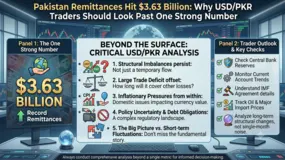
Abstract:While the calculation of the forex spread (the difference between the exchange rate at which a forex broker buys and sells the currency) is simple, yet some of us are left confused. To make it clear, we have come up with calculation and realistic examples to make you understand it better. Read on!
The dynamic foreign exchange market, where one currency is exchanged for another at a predetermined exchange rate, encompasses a wide range of concepts, including spreads. The spread, in simple terms, refers to the difference between the exchange rate at which a forex broker buys and sells the currency.
With a daily trading volume of approximately $7.5 trillion, the foreign exchange market involves massive participation from forex brokers, retail traders, hedge funds, central banks, and even governments.
The demand for currencies, their exchange rates, and, of course, the forex spread are all dependent on the trading activity during the day.
The calculation of the forex spread is simple, yet some of us are left confused. At the same time, people often ask - what is a good spread in forex trading?
In this article, we will calculate the spreads in forex and share more details associated with this concept. Keep reading!
Overview of Forex Trading
Forex trading involves the purchase and sale of currencies at their exchange rates with the hope that the rates speculated by traders turn right. Forex traders can purchase euros by exchanging USD at the prevailing exchange rate, which is also called the spot rate. Later, the trader can sell the euros to close their trades. The gain or loss for traders is dictated by the difference between the purchase and sale rates. Exploring spreads in forex trading will become clearer after understanding how brokers quote currencies.
A Short Guide to Currency Quoting
Currencies are always paired at exchanges. An example can be USD/CAD. Here, the first currency, which remains the USD, is the base currency. The second currency, CAD, is the second or quote currency.
Example - If $1.1500 (Canadian dollars) is required to purchase 1 USD, the USD/CAD would be represented as 1.1500/1 or 1.1500
Forex Spread Calculation
Similar to equity markets, forex quotes always come with bid and ask prices. The bid price is the one brokers are willing to purchase the base currency while exchanging the counter currency. In contrast, the ask price is the one at which the brokers are willing to sell the base currency while exchanging the counter currency.
The difference between the price at which the broker buys and sells a currency is called the bid-ask spread. If the trader initiates a sale transaction with the broker, the former would be quoted a bid price. If the trader looks to initiate a buy transaction, the broker will quote the ask price.
For instance, a US-based trader wants to take a long position or purchase euros. The bid-ask price on the trading website is found to be $1.200/1.250. Initiating a buy trade would result in an ask price of $1.250 for the trader. If the trader sells the euros back to the broker to close the position, the former would receive a bid worth $1.1200 per euro. The speculative trade thus costs the trader $0.0050 due to the bid-ask spread.
So, What is a Good Spread in Forex?
A good spread in forex is usually around 0.1 to 5 pips during normal conditions. Usually, currency pairs such as USD/EUR come with tight spreads. However, volatile market conditions can always make the spread rise. As a trader, you need to monitor the spread carefully, as speculative trades should cover or earn adequately to cover the spread and any charges you pay to the broker. Additionally, brokers can enhance their spread, which raises their profit on each trade. An increased bid-ask spread would result in traders paying more on purchases and receiving less on sales.
Events That Impact Forex Spreads
Trading Time
The time when the trade is initiated during the day remains critical. For example, European trading opens during the wee hours of the morning for US-based traders. On the other hand, Asian markets open late at night for European and US traders. The forex spread is estimated to be much wider when a euro trade is booked during the Asia trading session than when the trade is booked during the European session. If the currency trading does not witness a normal session, there will be fewer traders, triggering a lack of liquidity. In such a case, forex brokers enhance their spreads to cover the risk of a loss if they fail to get out of their position.
Events and Volatility
Forex spreads can widen significantly in the wake of unfavorable economic and geopolitical events. The Russia-Ukraine war and Israel and Israel-Iran conflict have significantly fluctuated the currency rates all over, resulting in wider spreads in forex trading.
Summing Up
Forex spreads may look like a small detail, but they play a huge role in determining the overall cost and profitability of trades. Understanding how spreads are calculated, what qualifies as a “good” spread in forex, and how market events and trading sessions influence them helps traders make smarter decisions.
Here is one special announcement that has made every forex lover interested.
Join the WikiFX Masterminds community to know whats kicking the forex market forward.
This is how you can be part of this group -
1. Scan the QR code placed right at the bottom.
2. Download the WikiFX Pro app.
3. Afterward, tap the ‘Scan’ icon placed at the top right corner
4. Scan the code again.
5. Great, you have become a community member.