


FOMC Minutes Today: 3 USD and Gold Scenarios Traders Should Prepare For
The Fed releases the July FOMC minutes on 19 August 2026. Here are three USD and gold scenarios, confirmation signals, and a practical risk checklist for traders.
Original

简体中文
繁體中文
English
Pусский
日本語
ภาษาไทย
Tiếng Việt
Bahasa Indonesia
Español
हिन्दी
Filippiiniläinen
Français
Deutsch
Português
Türkçe
한국어
العربية
اردو




Abstract:According to research, the value of international commerce has decreased overall by N2.55 trillion as a result of decreasing exports from Nigeria over the past year.
According to research, the value of international commerce has decreased overall by N2.55 trillion as a result of decreasing exports from Nigeria over the past year.
According to the National Bureau of Statistics' latest report on foreign trade statistics, the overall value of trade dropped from N14.6 trillion in the first quarter of 2022 to N12.05 trillion in Q1 2023.
Nigeria imported $5.56 trillion and exported $6.49 trillion in Q1 2023, demonstrating a trade surplus of $930 billion, the research states.
The report stated, “The value of total imports stood at N5.56tn in the first quarter of 2023, this represents a 3.67 per cent rise when compared with the value recorded in Q4, 2022 (N5.36tn), but declined by 25.83 per cent compared to the value recorded in the corresponding quarter of 2022 (N7.5tn).”
The value of imports and exports decreased, according to the data.
Exports dropped from N7.1 trillion in Q1 2022 to N6.49 trillion in Q1 2023, an 8.66% reduction in value.
As stated in the study, “The value of total exports in Q1, 2023 stood at N6.49tn indicating an increase of 2.00 per cent when compared with the value of exports in Q4, 2022 (N6.36tn), but decreased by 8.66 per cent when compared with the first quarter of 2022 (N7.10tn).”
Additionally, it was revealed that exports of manufactured goods, crude oil, oil products, energy goods, and raw materials items decreased in the first quarter of 2023.
Only the export of solid minerals and agricultural products saw growth, at 38.72 and 32.17 percent, respectively.
“The value of agricultural goods exports stood at N279.64 billion in Q1, 2023,” the report stated. “This shows an increase of 63.92 percent and 38.72 percent compared to the value recorded in Q4, 2022 (N170.59 billion) and Q1, 2022 (N201.59 billion),” it continued.
“The value of solid minerals exports in Q1 2023 was valued at N26.02 billion, indicating an increase of 23.73 percent and 32.17 percent compared to the value recorded in Q4 2022 (N21.03 billion) and in the corresponding quarter in 2022 (N19.69 billion), respectively,” it continued.
Forex shortage is to blame
The lack of access to foreign currency, the scarcity of local raw materials, and rising energy costs are just a few of the many difficulties local manufacturers face, according to Gabriel Idahosa, the deputy president of the Lagos Chamber of Commerce and Industry, which has played a significant role in preventing the manufacturing sector from reaching its full potential.
According to Idahosa, The manufacturing sector's performance is being impacted by a number of significant driving forces. Our manufacturing is heavily reliant on the importation of raw materials. Many of them struggle with more than just normal FX access. Since many of them are among the 41 commodities that CBN has blacklisted, they are completely dependent on the parallel market, where, as you are aware, the cost of foreign exchange is rising.
Similar concerns were repeated by Olusola Obadimu, Director-General of the Nigerian Association of Chambers of Commerce, Industry, Mines, and Agriculture. He claims that despite the struggling status of the industrial sector, the statistics body's data looks to be somewhat erroneous due to the large number of unauthorized exports that go unrecorded.
In a similar vein, Dr. Muda Yusuf, CEO of the Centre for the Promotion of Private Enterprise, highlighted that exports of manufactured goods to other nations have remained historically low as a result of the deluge of problems plaguing the manufacturing industry.

Disclaimer:
The views in this article only represent the author's personal views, and do not constitute investment advice on this platform. This platform does not guarantee the accuracy, completeness and timeliness of the information in the article, and will not be liable for any loss caused by the use of or reliance on the information in the article.
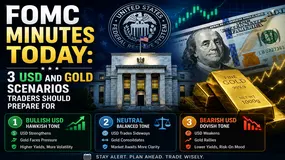
The Fed releases the July FOMC minutes on 19 August 2026. Here are three USD and gold scenarios, confirmation signals, and a practical risk checklist for traders.

A Prime of Prime forex arrangement can help a broker access trading relationships, credit intermediation, technology connectivity, and liquidity aggregation that may otherwise be difficult to obtain directly. But the label does not prove direct bank access, executable depth, or a particular execution outcome. This 2026 guide explains what a forex Prime of Prime, PoP liquidity provider, prime brokerage forex service, and forex prime broker proposal can mean in practice; where the credit and order-routing chain must be documented; how to test pricing, limits, rejects, records, and resilience; and which commercial terms create hidden operating cost. Use the comparison framework, red-flag list, and 90-day launch plan to assess fit for your client mix and risk model. The objective is a controllable execution dependency with traceable evidence, not a marketing claim about institutional access.
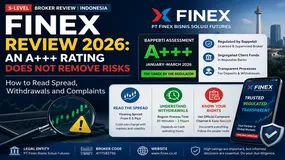
FINEX review 2026 for readers comparing an Indonesia forex broker: understand what Bappebti's A+++ rating does and does not show, then check floating spreads, withdrawals, segregated accounts and the complaint route for PT Finex Bisnis Solusi Futures.
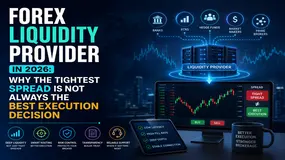
Choosing a forex liquidity provider is not a search for the lowest displayed spread or the longest provider list. It is a broker decision about pricing integrity, depth, routing, credit, reporting, incident response, and client communication. This 2026 guide explains how a forex LP, FX liquidity provider, or liquidity provider forex arrangement fits into a broker’s execution chain; what to test before onboarding; why a “best forex liquidity provider” claim cannot replace due diligence; and how to compare cost beyond commission. Use the execution-quality scorecard, provider questions, routing scenarios, and 90-day onboarding plan to assess whether a liquidity relationship can support your actual client mix, instruments, risk model, and jurisdiction. The goal is not to make a universal ranking. It is to build evidence that your broker can explain, supervise, reconcile, and recover its execution service when market conditions are difficult.
WikiFXWikiFXWikiFXWikiFXWikiFXWikiFXWikiFXWikiFXWikiFXWikiFX