


UK Retail Sales July 2026 Fall 0.5%: What the Result Means for GBP
UK retail sales fell 0.5% in July 2026, while the three-month measure rose 1.1%. See the ONS details and what the mixed result may mean for GBP.
Original

简体中文
繁體中文
English
Pусский
日本語
ภาษาไทย
Tiếng Việt
Bahasa Indonesia
Español
हिन्दी
Filippiiniläinen
Français
Deutsch
Português
Türkçe
한국어
العربية
اردو




Abstract:According Cowry Asset Management Ltd, the Central Bank of Nigeria's (CBN) bringing of fewer new banknotes may intensify the pressure on the naira on the FX market.

According to Cowry Asset Management Ltd, the Central Bank of Nigeria's (CBN) bringing of fewer new banknotes may intensify the pressure on the naira on the FX market. Despite naira volatility at the Investors and Exporters' (I&E) window section of the FX market last week, in a report released over the weekend that the pressure on the local currency brought on by the lack of fresh naira notes will not soon go away. They claim that “the argument persists that the naira might fall further across the FX market, with the imposition of withdrawal limits, due to increased demand of the naira, economy panic, and the exclusion of the unbanked, the financially underserved, and informal traders from the inclusion plan.”
The deadline for using the old note as a means of payment expired on Friday; but, the extension for the return of old banknotes continues while the Supreme Court and the Council of States, after its meetings, have ordered the apex bank to keep the old banknotes with an effort to ease the hassles faced by Nigerians. Despite increasing FX pressure on the naira and the newly revised note, the naira traded in a peaceful way to close at N461.50/USD in the just concluded week at the investors' and exporters' FX window.
The naira, on the other hand, lost value versus the dollar in the parallel market, where it fell by 0.7% or N5 week over week to N755/USD from N750/USD. As a result, market participants maintained I&E bids between N460 and N465 USD, while open market was between N750 and N757 USD. “In our view, the naira demand pressure is projected to stay unabating given the local currency,” they continued. As we steadily transition to the cashless policy environment, this further demonstrates the central bank's failure to supply the local currency.
As the February 25 presidential election approaches, the naira will drop value even more, particularly on the black market. Last Friday, the naira plummeted to N755/$1 on the parallel market compared with N461.5/$1 at the official I&E window. A financial news website over the weekend quoted Aminu Gwadabe, the president of the Association of Bureaux De Change Operators of Nigeria (ABCON), as claiming that the currency redesign strategy was not currently having a beneficial influence on the value of the naira. The redesigned naira hasn't had a favorable impact on the value of the local currency relative to the dollar because there isn't much liquidity in the market. Coronation Merchant Bank recently presented its Economic Review and 2023 projection, which included the company's forecast that the I&E exchange rate would likely end the year at N505/$1.
The analysts observed in the research titled “Baton hand-off: Economic headwinds and expected resilience” that there is a potential of a devaluation in H2 2023 due to liquidity concerns, despite anticipation for increasing oil revenue, which might bolster FX liquidity and lead to a minor appreciation of the naira. Due to a lack of market liquidity, the redesigned naira hasn't had a positive effect on the value of the local currency in relation to the dollar. In a recent presentation of its Economic Review and 2023 prognosis, Coronation Merchant Bank included its prediction that the I&E exchange rate will probably conclude the year at N505/$1. While there is optimism for increased oil revenue, which could boost foreign exchange liquidity and cause the naira to appreciate, it was said that in the report titled “Baton hand-off: Economic headwinds and expected resilience” that there might be a devaluation in H2 2023 because of liquidity issues.

Disclaimer:
The views in this article only represent the author's personal views, and do not constitute investment advice on this platform. This platform does not guarantee the accuracy, completeness and timeliness of the information in the article, and will not be liable for any loss caused by the use of or reliance on the information in the article.
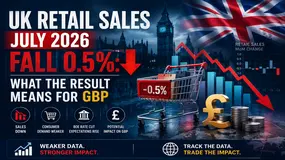
UK retail sales fell 0.5% in July 2026, while the three-month measure rose 1.1%. See the ONS details and what the mixed result may mean for GBP.

Pakistan forex reserves stood at $22.506 billion on 13 August 2026, while the SBP dashboard showed a USD/PKR mark to market rate of 277.5713 on 20 August. This article separates the SBP forex reserves facts from predictions about the Pakistan rupee and the forex market Pakistan.

A multi-asset liquidity solution can help a broker support FX, CFDs, commodities, and indices through a more unified operating model. But adding asset classes can also create fragmented symbols, pricing, routing, margin rules, records, and client messages if controls are not designed first. This 2026 guide explains how a multi asset liquidity provider, forex CFD liquidity setup, commodity liquidity provider, and indices liquidity provider fit into a broker-owned execution service. It outlines the due-diligence questions, shared-control model, cost drivers, and 90-day implementation plan that help teams expand without making the execution chain harder to explain. The aim is not to promise deeper liquidity or better trading outcomes. It is to create evidence that a broker can supervise market access, trace order events, reconcile costs, and communicate consistently to the relevant clients when conditions are difficult.

Gold surged above $4,500 after the US Treasury expanded its purchases of longer-dated government bonds, pushing yields and the dollar lower. But this was not debt forgiveness or Federal Reserve money printing—it was a liquidity operation that exposed a much bigger fear: America may be finding it increasingly difficult to live with market-driven interest rates.
WikiFXWikiFXWikiFXWikiFXWikiFXWikiFXWikiFXWikiFXWikiFXWikiFX