World Cup Fever Is Here! Choose your broker like you choose your team
Join WikiFX and investors worldwide in celebrating the excitement of the 2026 FIFA World Cup!
简体中文
繁體中文
English
Pусский
日本語
ภาษาไทย
Tiếng Việt
Bahasa Indonesia
Español
हिन्दी
Filippiiniläinen
Français
Deutsch
Português
Türkçe
한국어
العربية
اردو
Abstract:Asia-Pacific bond yields followed U.S. Treasury yields higher on Wednesday and the dollar continued its climb after Federal Reserve officials signalled they are nowhere near done raising interest rates.
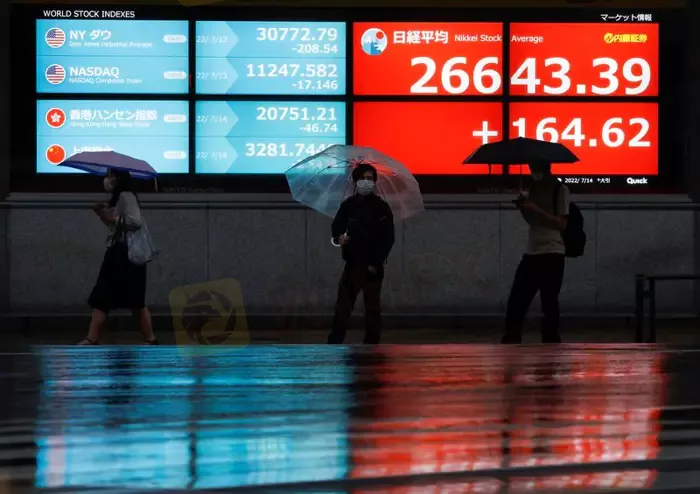
Stocks rose in volatile trading across Asia on Wednesday and the dollar pared early gains as investors weighed the potential fallout from U.S. House Speaker Nancy Pelosis visit to Taiwan, which has angered China.
Bond yields were also helped as demand for the safest assets eased despite heightened tensions between the United States and China, which views Taiwan as a breakaway province.
“In the longer term, there will be more frictions between the U.S. and China,” said Redmond Wong, Greater China market strategist at Saxo Markets in Hong Kong. “We have already been seeing selling from overseas investors in Chinese equities.”
Japan‘s Nikkei closed up 0.53%, rebounding from Tuesday’s two-week closing low, while Hong Kong‘s Hang Seng gained 0.83% and Taiwan’s TAIEX index rebounded from earlier losses to gain 0.2% at the close.
MSCI‘s broadest index of Asia-Pacific shares rose 0.19%, helped by the rally in Japan as bargain hunters came in following Tuesday’s decline to a two-week closing low.
Australias AXJO fell 0.41% and Chinese blue chips lost 0.13%.
“Obviously, as investors in China, we would not like to see tensions escalate,” said Thomas Masi, vice president and co-portfolio manager of the GW&K Emerging Wealth Strategy.
“And we don‘t see the benefit necessarily of this trip, but there could be something that we don’t understand. On a risk-reward basis, should tensions ease, theres a lot more upside in these stocks.”
FTSE futures were down 0.20% and Euro STOXX 50 futures dropped 0.08% ahead of markets opening in Europe.
U.S. stock futures jumped 0.32%, following the S&P 500s 0.67% drop overnight.
A trio of Fed policymakers signalled on Tuesday that there would be no let up in the tightening campaign aimed at taming the highest inflation since the 1980s, even though it will take rates to a level that will more significantly curb economic activity.
Two of them, San Francisco Fed President Mary Daly and Chicago Fed President Charles Evans, are widely regarded as doves.
Traders now see a chance of around 39.5% that the Fed will hike by another 75 basis points at its next meeting in September.
The benchmark U.S. 10-year Treasury yields were around 2.71% in Tokyo, not far from the overnight high of 2.774% following a 14 basis point surge.
The U.S. dollar index, which gauges the currency against the yen and five other major peers, was 0.188% lower at 106.25, having rebounded as much as 1.43% overnight following its slide to a nearly one-month low at 105.03.
Gold gained 0.57% higher to $1,769.73 per ounce, but following a 0.68% retreat the previous session.


Disclaimer:
The views in this article only represent the author's personal views, and do not constitute investment advice on this platform. This platform does not guarantee the accuracy, completeness and timeliness of the information in the article, and will not be liable for any loss caused by the use of or reliance on the information in the article.

Join WikiFX and investors worldwide in celebrating the excitement of the 2026 FIFA World Cup!

Have you experienced issues with Pepperstone deposit & withdrawal processing? From your experience, do you feel that the Australia-based forex broker causes losses to its clients? Did the brokerage entity freeze your account and give you a margin call? All these trading allegations have been rampant on broker review platforms such as WikiFX. This Pepperstone review article takes a close look at the user complaints, especially in 2026. Additionally, we have given an overview of the regulatory framework under which the brokerage entity operates.

Some broker comparisons end with a confident "go with this one." This is not one of them — and that honesty is exactly what makes it worth reading. Wundersys and tradgrip are two young, offshore-registered brokers that keep popping up in front of beginner traders, often through aggressive online marketing. Both promise the usual buffet: tight spreads, generous leverage, multiple account tiers. And both, according to WikiFX, sit near the very bottom of the safety scale. So instead of crowning a champion, this comparison is really about something more useful: learning to read the warning signs, understanding the small differences that still matter, and knowing why "the better of two risky options" is still a conversation about risk.

If you trade forex from India, Pakistan, Bangladesh, Sri Lanka, or Nepal, you already know the quiet truth that eats into every trader's results: it is not just the market that decides whether you profit — it is the cost of getting in and out of each trade. Shave a couple of dollars off your commission on every lot, multiply it across hundreds of trades a year, and you are looking at the difference between a strategy that works and one that bleeds out slowly. South Asian traders are some of the most cost-conscious in the world, and rightly so. So we pulled the data on the brokers most often recommended for the region, cross-checked every name on WikiFX, and ranked them by the one number that matters most here: what they actually charge you to trade. Before the list, one quick lesson that will make this whole ranking click.