


FOMC Minutes Today: 3 USD and Gold Scenarios Traders Should Prepare For
The Fed releases the July FOMC minutes on 19 August 2026. Here are three USD and gold scenarios, confirmation signals, and a practical risk checklist for traders.
Original

简体中文
繁體中文
English
Pусский
日本語
ภาษาไทย
Tiếng Việt
Bahasa Indonesia
Español
हिन्दी
Filippiiniläinen
Français
Deutsch
Português
Türkçe
한국어
العربية
اردو




Abstract:The Federal Reserve on Wednesday cut interest rates for the third time this year to help sustain U.S. growth despite a slowdown in other parts of the world, but signaled there would be no further reductions unless the economy takes a turn for the worse.
The Federal Reserve on Wednesday cut interest rates for the third time this year to help sustain U.S. growth despite a slowdown in other parts of the world, but signaled there would be no further reductions unless the economy takes a turn for the worse.
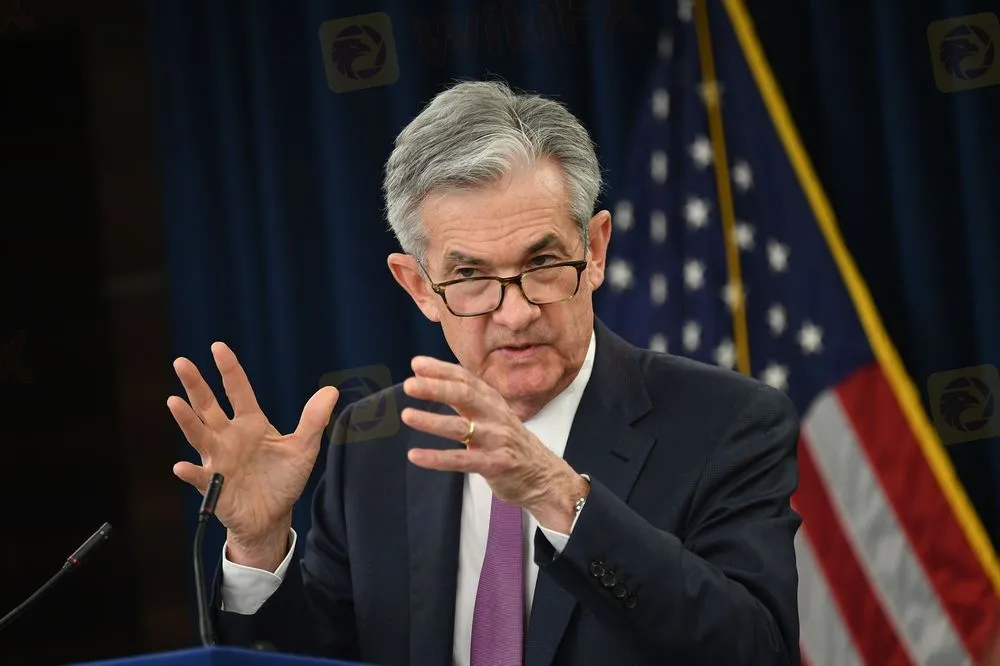
“We believe that monetary policy is in a good place,” Fed Chair Jerome Powell said in a news conference after the U.S. central bank announced its decision to cut its key overnight lending rate by a quarter of a percentage point to a target range of between 1.50% and 1.75%.
“We took this step to help keep the economy strong in the face of global developments and to provide some insurance against ongoing risks,” he said. “We see the current stance of monetary policy as likely to remain appropriate as long as incoming information about the economy remains broadly consistent with our outlook.”
Powell‘s comments clash with President Donald Trump’s demands that the Fed cut rates even deeper to boost economic growth that ebbed to a 1.9% annual rate in the third quarter, well below the 3% level Trump pledged would flow from a round of tax cuts and other actions nearly two years ago.
But the Feds new stance also vouched for both the seeming durability of a U.S. economic expansion that is now the longest on record.
In his news conference, Powell ticked off an extensive list of reasons why he feels the economy is doing well, and likely to continue to do so under the current stance of monetary policy - from robust consumer spending, strengthening home sales, and asset prices he considered healthy but not to a level of excess.
As well, Powell said, some of the risks that had most unnerved Fed officials, and convinced them lower rates were needed if only as “insurance,” have seemed to abate in recent weeks.
The U.S.-China trade was “a step closer” to resolution, Powell said, and it looked less likely that Britain would crash out of the European Union.
The outlook for the U.S. economy continues to be for “moderate” growth, a strong labor market and inflation rising back to the Feds 2% annual goal, he said, and only “a material reassessment” of that outlook could drive the central bank to cut rates further from here.
DISSENTS
In the statement accompanying its decision to cut rates, the Fed dropped a previous reference that it “will act as appropriate” to sustain the economic expansion - language that was considered a sign for future rate cuts.
Instead, the central bank said it will “monitor the implications of incoming information for the economic outlook as it assesses the appropriate path” of its target interest rate, a less decisive phrase.
Kansas City Fed President Esther George and Boston Fed President Eric Rosengren dissented from the decision. They have opposed all three Fed rate cuts this year as unnecessary.
St. Louis Fed President James Bullard, who had dissented in September because he supported a bigger rate cut then, voted with the majority on Wednesday, an indication that views within the Fed may be coalescing around standing pat for now.
The rate cut was widely anticipated by financial markets, but expectations for additional cuts after October have diminished significantly in recent weeks. Contracts tied to the Federal Funds rate indicate an expectation of perhaps one rate cut next year.
While yields on longer-dated bonds showed little reaction, those on shorter-dated maturities that are more closely influenced by Fed policy expectations initially moved higher. The yield on the 2-year note US2YT=RR rose to the highest since Oct. 1 at about 1.67% before settling back to earlier levels as Powell spoke.
“Its pretty much what was expected,” said Jim Powers, director of investment research at Delegate Advisors.
“The more important outcome is they removed the phrase ‘act as appropriate.’ It looks like the market is taking that to mean that there will be a pause in the declining rate path they were on beforehand. That‘s what was expected, and that’s generally a good thing,” Powers said.
UNUSUAL JUNCTURE
The central bank and U.S. economy are at an unusual juncture.
Unemployment is near a 50-year low, inflation is moderate, and data earlier on Wednesday showed economic growth in the third quarter slowed but not as sharply as many economists expected and some Fed officials feared.
But parts of the economy, particularly manufacturing, have stuttered in recent months as the global economy slowed. Businesses have pared investment in response to the U.S.-China trade friction that both raised tariffs on many goods, and also made the world a riskier place to make long-term commitments.
While that has not had an obvious impact yet on U.S. hiring or consumer spending, Fed officials felt a round of “insurance” rate cuts was appropriate to guard against a worse outcome. The Fed cut rates in July and again in September, and by doing so hoped to encourage businesses and consumers with more affordable borrowing costs.
The approach was successful in the 1990s when risks developed during another prolonged period of economic growth.
Disclaimer:
The views in this article only represent the author's personal views, and do not constitute investment advice on this platform. This platform does not guarantee the accuracy, completeness and timeliness of the information in the article, and will not be liable for any loss caused by the use of or reliance on the information in the article.
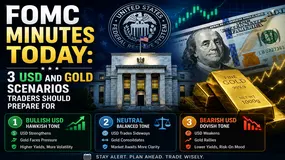
The Fed releases the July FOMC minutes on 19 August 2026. Here are three USD and gold scenarios, confirmation signals, and a practical risk checklist for traders.
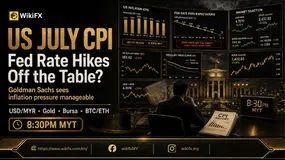
Goldman Sachs expects inflation to remain manageable as America’s labour market loses momentum. For Malaysian investors, the result could influence the US dollar, ringgit, gold and Bursa sentiment.
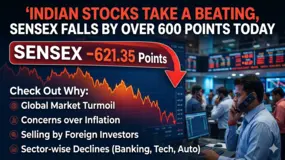
Indian stock markets witnessed a sharp low in the early trading hours on Monday. While the Sensex fell by more than 600 points, Nifty slumped under 23,200. The fall in the stock market today is the investors’ reaction to the escalating tensions in the Middle East, a surge in crude oil prices and weakness across markets worldwide. At around 9:30 a.m. on June 8, 2026, the BSE Sensex dropped by 627.47 points to 73,615.87, recording a fall of 0.85%. At the same time, the Nifty declined by 195.40 points to 23,171.30, registering a 0.84% fall. The selloff was broad based, with most sectoral indices slipping into red. Nifty IT, Nifty Realty, Nifty Auto and Nifty Metal slipped by 1.61%, 1.68%, 1.21% and 1.31%, respectively. Even the Nifty Midcap 100 and Nifty Smallcap 100 declined by 0.73% and 0.63%, respectively. As far as Sensex stocks are concerned, only State Bank of India, Axis Bank, Power Grid Corporation of India and Sun Pharmaceutical Industries were found to be green. Among the one

A power struggle over the future of the Federal Reserve is intensifying as Treasury Secretary nominee Scott Bessent spearheads a process to select the next Fed Chair, aiming to align the central bank more closely with the White House's economic agenda.
WikiFXWikiFXWikiFXWikiFXWikiFXWikiFXWikiFXWikiFXWikiFXWikiFX